Plain-English summary#
PDF Templates control how your receipts, invoices, POs, and credit notes look when printed or emailed — logo placement, footer text, colour scheme, which fields appear. Transaction Series control the numbering — "SO-0001/2026" vs "INV-2026-001" — including annual resets so the count restarts each year. Together they set the look and numbering of every document Foodops produces.
When you'd use this#
- Brand setup — upload your logo, set header/footer, choose the receipt layout
- Compliance — make sure tax invoices include all legally required fields (TIN, GST registration, etc.)
- Start of the financial year — check that annual-reset series restart correctly
- Multi-brand — different PDF templates per outlet/brand
How to access#
- Sidebar: admin.foodops.io → Settings → Customisation section → PDF Templates or Transaction Series
PDF Templates#
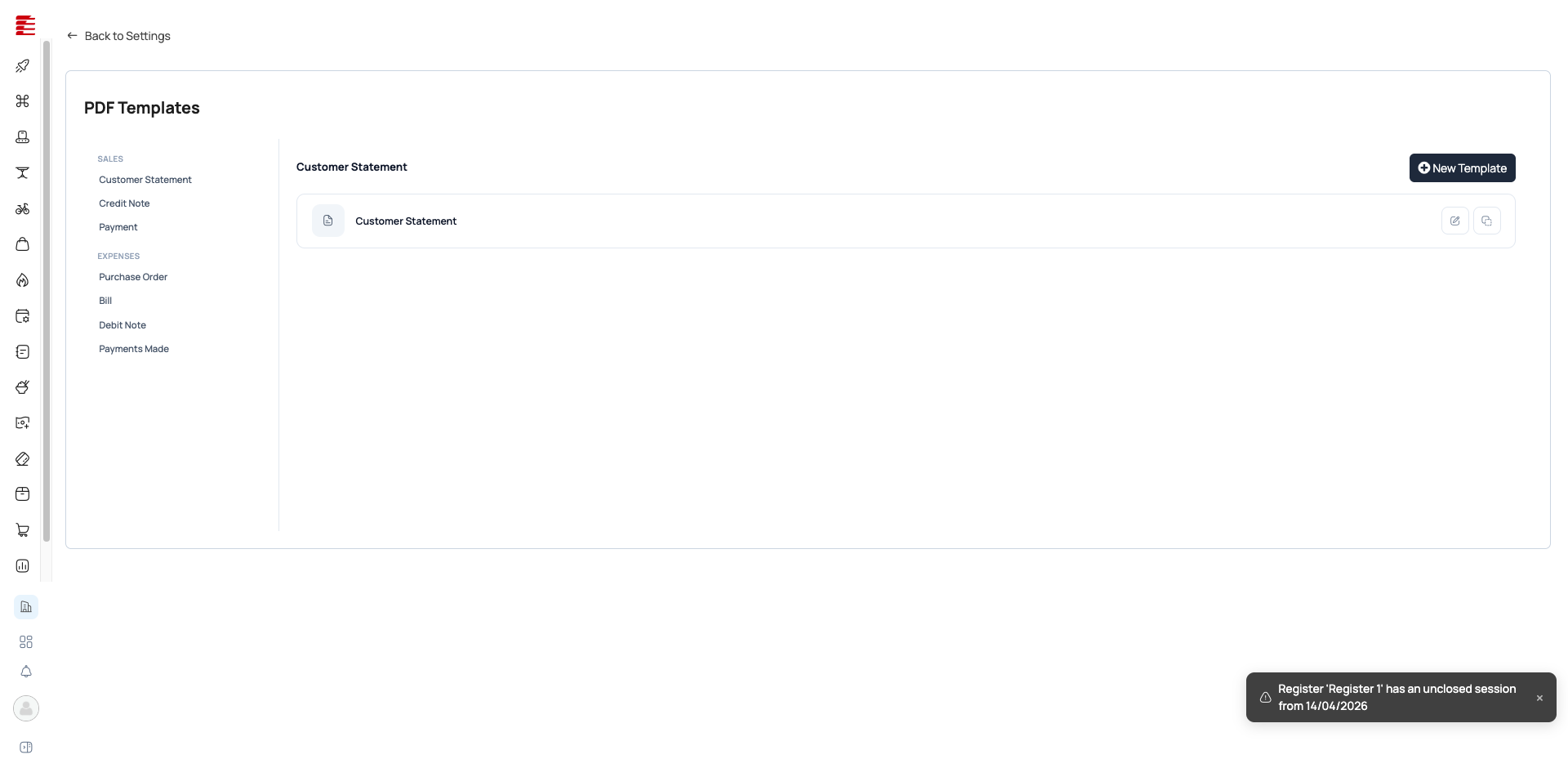
Templates are listed in one table with Name, Document type, Default, Updated and an actions column. Use the document-type filter to narrow the list. Document types you can make a template for: Invoice, Payment, Credit Note, Customer, Bill, Payment Made, Debit Note, Quote, Purchase Order, Sales Order, Retainer Invoice, Customer Statement, Proforma Invoice, Delivery Note and Packing List.
Each document type can have several versions. The one marked Default is the one Foodops uses; to switch, open the template you want and tick Default in the editor toolbar.
The template editor Clicking Add template or Edit opens a full-page document template editor in three columns: a Palette of blocks you click to add (Heading, Text, Image / Logo, Spacer, Divider, Two-column Row, Company Address, Customer / Supplier, Key/Value Table, Document Title + No., Line Items Table, Totals, Signature, Footer Text, Custom HTML - 15 block types), a paper-sized Canvas with margin guides and header/footer areas, and a Properties panel for whatever you've selected. Opening an existing template loads its saved layout. In the editor you can click a block in the Palette to add it to the header, body or footer, and drag blocks in the canvas to reorder them; switch between Visual | HTML views; see a live Preview; undo/redo (Cmd/Ctrl+Z / Shift+Z); save with Cmd/Ctrl+S; and you're warned before closing the tab with unsaved changes.
What you can customise per template (in the editor and Properties panel):
- Logo — Image/Logo block; upload your company logo and position it with the block
- Header / Footer — header and footer areas with their own blocks (free text, addresses, etc.), which you can switch on/off and position per page
- Block styling — heading/text styling per block, plus placeholders you can insert to pull in document and line-item details
- Field visibility — the Line-Items Table block lets you show or hide each column (e.g., hide TIN on walk-in receipts, show it on tax invoices)
- Paper size & orientation — A4 / Letter / Legal / A5, portrait/landscape, with margins, set for the whole template
For invoices, the template used comes from the invoice template chosen on the sales register. If you haven't set one up, Foodops uses a default template.
Transaction Series#
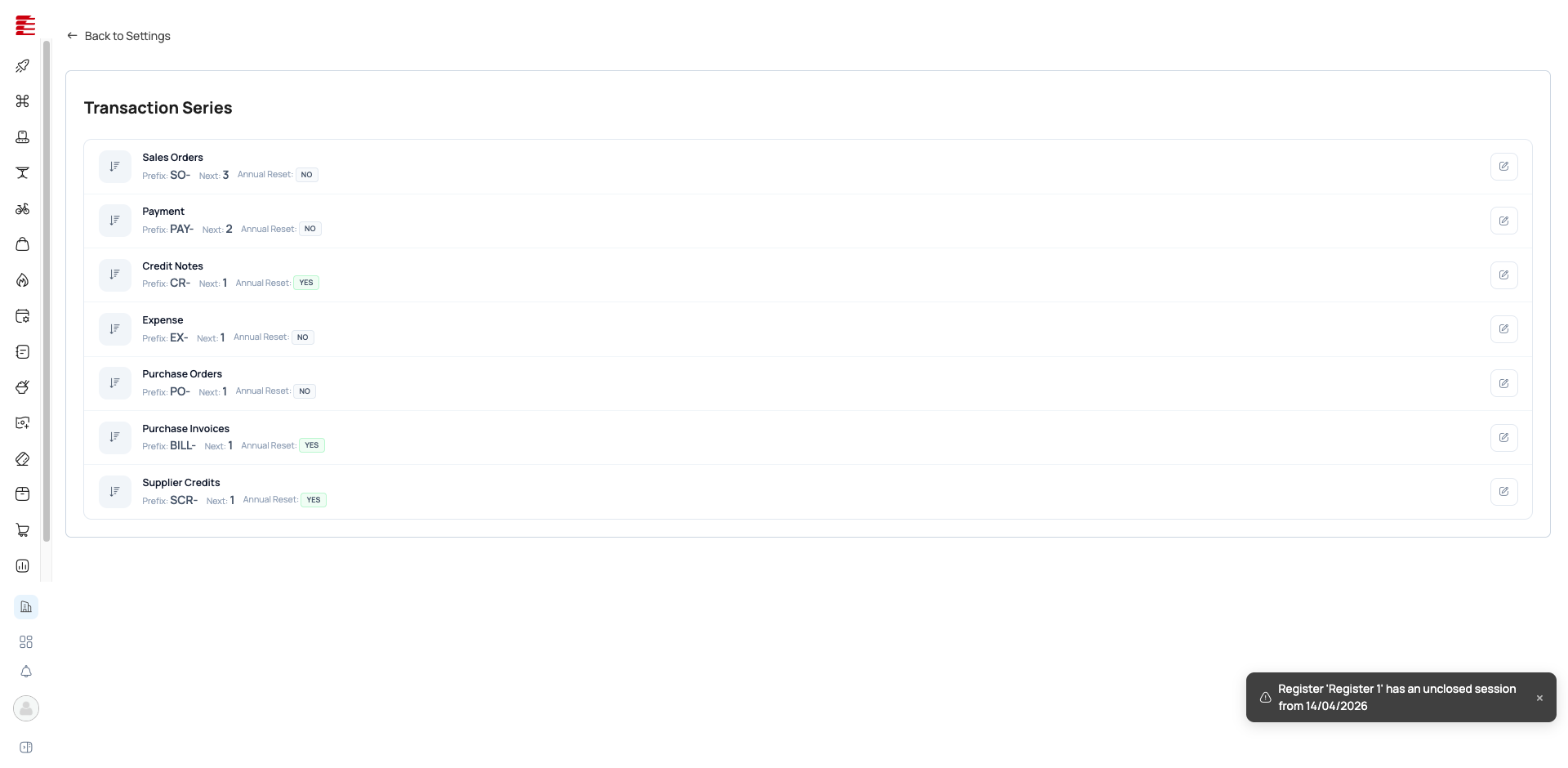
Seven built-in series:
| Series | Prefix | Next | Reset annually |
|---|---|---|---|
| Sales Orders | SO- | 3 | No |
| Payment | PAY- | 2 | No |
| Credit Notes | CR- | 1 | Yes |
| Expense | EX- | 1 | No |
| Purchase Orders | PO- | 1 | No |
| Purchase Invoices | BILL- | 1 | Yes |
| Supplier Credits | SCR- | 1 | Yes |
Info: Reset annually Series with Reset annually = Yes restart at 1 on January 1 each year. The year is added to the number (e.g., CR-0001/2026 → CR-0001/2027). Series without annual reset keep counting up forever. Choose based on your accounting practice.
Each series can be edited:
| Field | Purpose |
|---|---|
| Prefix | Text before the number (e.g., "SO-", "INV-") |
| Next number | The next number to be given out. You can change it if you need to skip ahead or line up with another system |
| Reset annually | Whether the count restarts each January 1 |
Key concepts#
- PDF Template - the design for a document type. Controls layout, branding and which fields show. Several templates per type; the one marked Default is used.
- Transaction Series — the numbering for a document type. Prefix + a number that counts up + optional yearly restart.
- Reset annually - the count restarts at 1 each year. Useful for numbering by financial year (tax authorities sometimes require sequential numbering per year).
- Next number - can be changed. Use with care - skipping numbers can raise questions in an audit. Setting a lower number is allowed but leaves your records out of sequence.
- Thermal receipt — 80mm-wide template for POS thermal printers. Different from the A4 templates used for emailed/printed invoices.
Common questions#
Q: How do I add my logo to receipts? A: PDF Templates → pick the relevant template (e.g., "Payment" for POS receipts) → upload your logo. It appears on every future print/email of that template type.
Q: Can I have a different receipt look per outlet? A: Templates apply to your whole organisation by default. Multi-brand setups on higher plans can assign different templates per brand. With one brand and several outlets, all outlets share the same template.
Q: What happens if I edit a Transaction Series prefix mid-year? A: New documents get the new prefix; past documents keep the old one. Both appear in reports — not recommended mid-year, to keep audits clear.
Q: The "Next number" shows 3 for Sales Orders but I've only created 1 order - why? A: Voided or draft orders may have used numbers without being completed. Numbers are given out when a document is created, not when it's completed — cancelled orders still "use up" a number so every number can be accounted for.
Q: Can I create custom series (e.g., for delivery notes)? A: The 7 built-in series cover the standard document types. You can't create your own series from the screen — contact support if you need one.