

Plain-English summary#
Cash handling in Foodops covers every movement of money into or out of the drawer during a register session — from the opening float counted in at the start of a shift, through cash a manager takes out mid-shift for a bank run, to the note-by-note count at close that gives you the variance. Every cash event is logged against the session and is visible to anyone who can see that session's details. The closing variance — the difference between what Foodops expected in the drawer and what was actually counted — is the main thing to check at end of shift.
When you'd use this#
- Opening a shift — entering the starting float note by note
- Mid-shift — a manager takes cash from the drawer and logs it so the expected balance stays accurate
- Outlets that deliver — acknowledging cash that riders bring back to the register
- End of shift — counting the closing cash by denomination and understanding the variance
- Investigating a discrepancy — finding which cash event caused a mismatch between expected and counted
Key concepts#
- Opening balance / float — the cash put in the drawer when the session opens, entered by denomination. The starting point for Expected.
- Expected balance — the cash total Foodops calculates: Opening + cash sales − refunds − withdrawals. Delivery cash counts through the cash payment on the delivery order. Shown per payment method in the Expected column on the Session Details Overview tab.
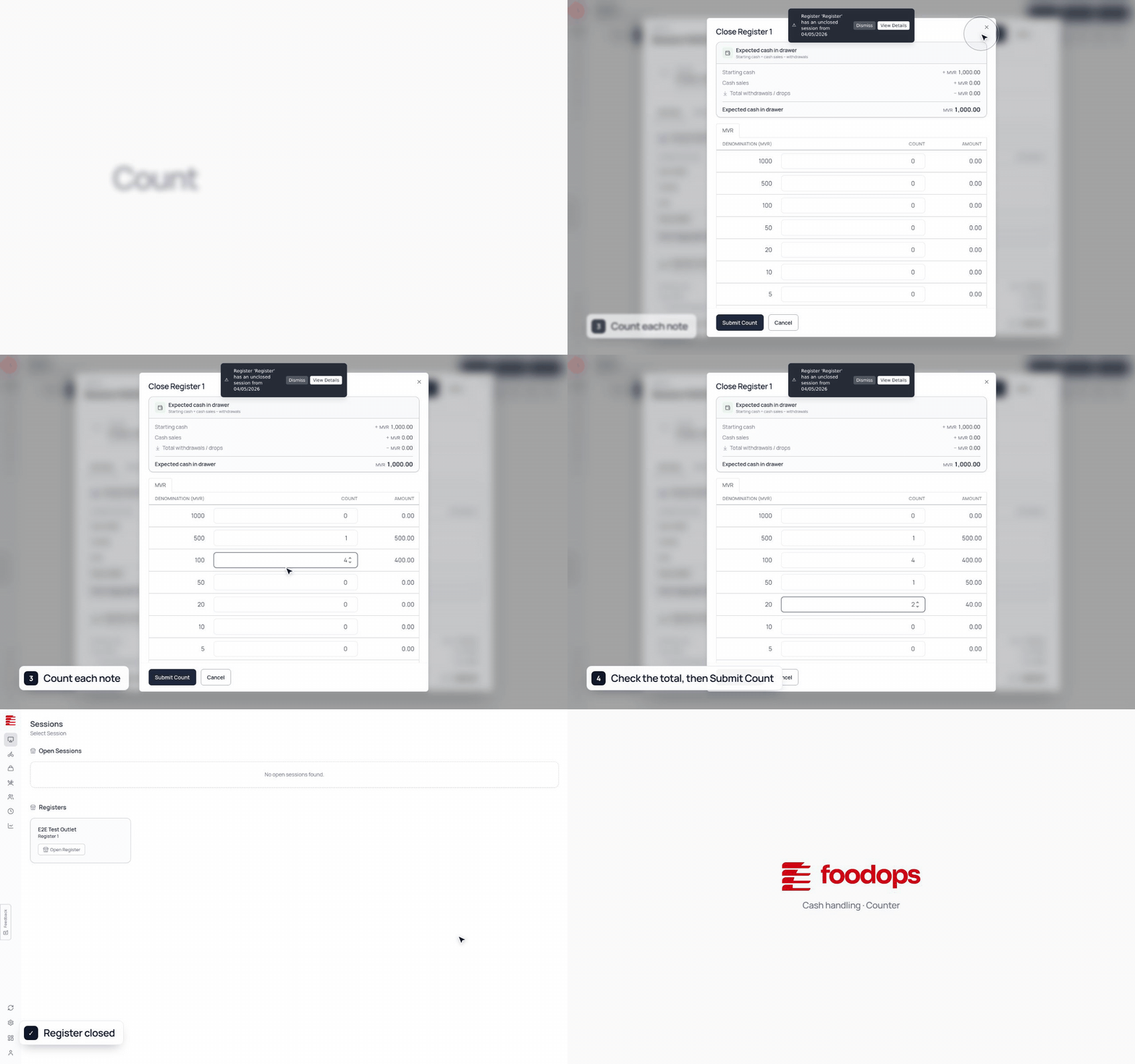
- Counted balance — the cash physically counted at close, entered by denomination on the Close Register form. It becomes the session's Closing Balance.
- Variance / Difference — Counted minus Expected (negative = short, positive = over). Zero is the target; anything else triggers review.
- Cash withdrawal — cash a manager records taking out of the drawer mid-shift. Logged in the Cash Withdrawal tab; reduces Expected.
- Delivery cash — cash from delivery orders that riders bring back to the register. Acknowledge it in the Delivery Cash tab.
- Denomination count — entering how many of each note and coin, rather than one total. Gives you a breakdown you can trace when investigating a discrepancy.
Common questions#
Q: Can I enter a zero opening float? A: Yes — a zero (or empty) opening count is accepted, and the Opening Balance is simply zero. There just won't be any cash in the drawer to make change. Check with management whether a zero-float shift is allowed at your outlet.
Q: I entered the wrong opening float and the session is already open. What do I do?
A: If no orders have been taken, close the session with Close Register (a zero-sale close) and reopen it with the correct denominations. If orders have been taken, there's no way to change the Opening Balance on an open session — carry on with the shift, and the wrong float will show as a matching cash variance at close. Add a note in the close Comments explaining it, and tell your manager so the variance is expected at reconciliation.
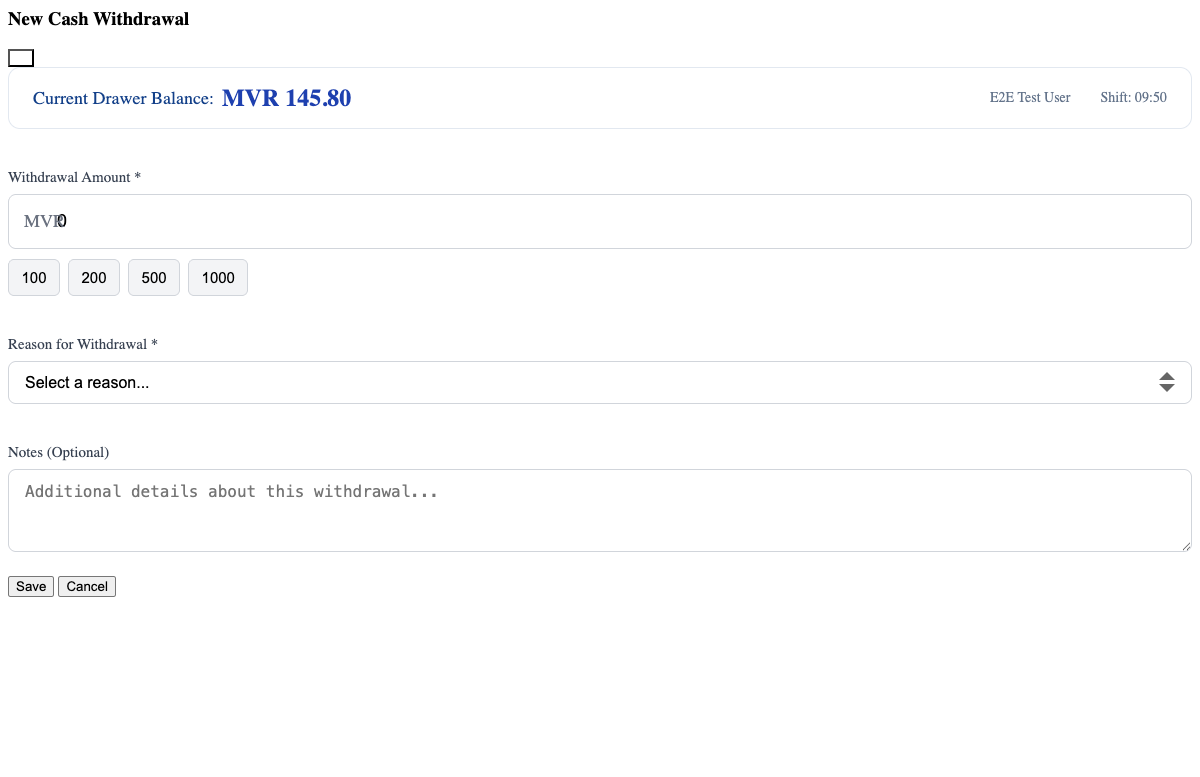
Q: Who can record a cash withdrawal? A: Anyone with an open session on the register can start a withdrawal — the New Withdrawal button isn't limited by role. The check is by amount: a withdrawal at or below the register's authorisation limit goes through straight away; one above the limit needs a manager's OTP authorisation before it's recorded. The New Cash Withdrawal form shows: Current Drawer Balance (for information), Withdrawal Amount (required, with MVR quick-fill buttons 50/100/500/1000), Reason for Withdrawal (required: Petty Cash / Supply Purchase / Delivery Tips / Emergency Expense / Bank Deposit Preparation / Other), Notes (optional), and Save / Cancel.
Q: Do cash withdrawals automatically reduce the Expected balance? A: Yes — at close, all withdrawals recorded on the session (and not deleted) are subtracted from the cash Expected for the base currency. If you take out MVR 500 mid-shift and record it, Expected at close is MVR 500 lower. If you take the cash but forget to record it, the drawer will look short by that amount at close.
Q: What happens if I close without acknowledging delivery cash?
A: Acknowledging a hand-over doesn't change the Expected balance by itself — Expected comes from cash payments and withdrawals. Still, acknowledge all delivery cash in the Delivery Cash tab before closing, so rider cash is reconciled and its cash payment is in place. If cash is in the drawer but its cash payment was never recorded, it shows as an unexplained over at close.