Plain-English summary#
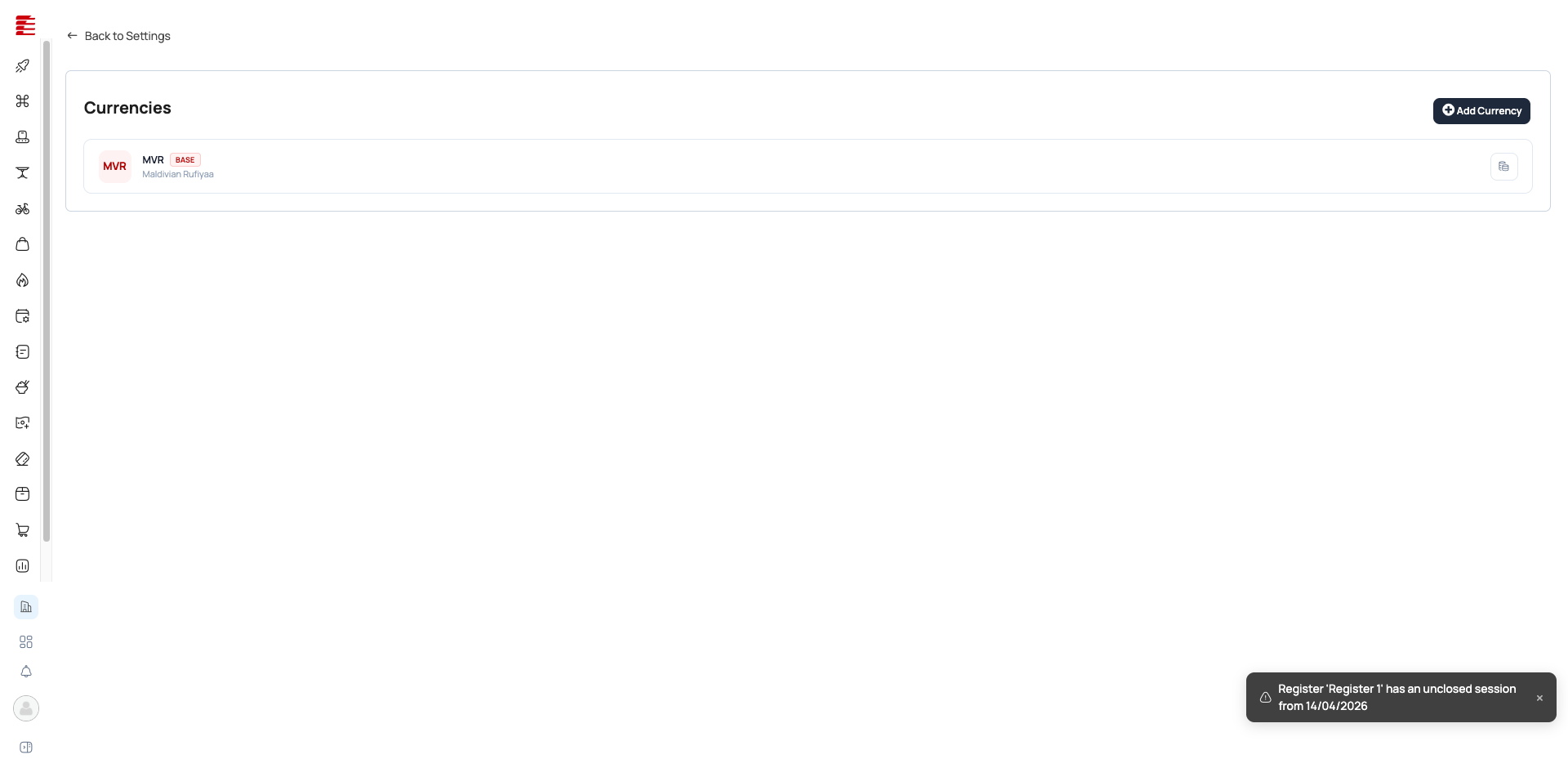
Foodops uses Maldivian Rufiyaa (MVR) by default, but you can add other currencies — useful when paying suppliers in USD, serving tourists in EUR, or running a business across countries on one account. You enable each currency in Settings; customers and suppliers can then have a default currency different from your base currency.
When you'd use this#
- Paying an international supplier in USD while selling in MVR
- Invoicing a foreign corporate client in their currency
- Resort operations accepting payments in several currencies at the counter
- Reporting revenue in both local and foreign currencies
How to access#
- In the admin back office (admin.foodops.io): Settings → Accounting → Currencies
Key concepts#
- Base currency — your organisation's home currency (MVR for Maldives businesses). Reports convert everything to this for combined views.
- Transaction currency — the currency on a specific PO, Bill or Invoice. It sets the amount on the document, which is converted to base at the document's exchange rate for reporting.
- Exchange rate — entered by hand, and fixed when a document (PO, Invoice, Bill) is created. Changing the rate in Settings doesn't update existing documents.
Common questions#
Q: Can I accept USD at the POS counter? A: Not directly — POS sales are in MVR. To take other currencies at the POS, use a payment gateway that handles the conversion (the customer pays by USD card, the gateway settles in MVR to your account).
Q: How often should I update exchange rates? A: It depends on how much rates move. MVR is pegged to USD within a band, so monthly is usually fine. For EUR/GBP, weekly — or daily when rates are moving a lot.
Q: Does changing the exchange rate affect past transactions? A: No. Each document keeps the rate from when it was created. Changing the rate only affects new documents.
Q: Can I have a customer priced in USD but report revenue in MVR? A: Yes — that's how it works by default. The customer's invoices show USD; your reports show the MVR equivalent at the invoice-date rate. Both amounts are kept.